
Brisco Bolt
Owners Manual

43 St Marks Rd. Toronto, Ont. Canada M6S 2H5
Phone: 647-893-6286
E-mail: briscosteelguitars@gmail.com
www.briscoguitars.com
Introduction
The Brisco Bolt is a high quality, entry level pedal steel guitar. This owners manual will help you become familiar with the general mechanics and maintenance of the instrument. For more information please visit our website. Please contact us if you need any technical support or have any questions.
Assembly
The Brisco Bolt is carried in a thick padded soft shell case. The guitar is placed bottom side up. A divider board is placed on top of the guitar. The pedal bar, rods and legs are placed in a pouch that sits on top of the diver board. This will ensure the guitar is protected during transportation.
When you open the case, remove the leg pouch and divider board. Leave the guitar in the case, bottom side up. Screw the front legs first. You can identify these legs by the groove at the bottom for the pedal bar. Once the front legs are in place, attach the pedal bar. Loosen the wingnuts and move the sliders. Once in place tighten the wingnuts. Now install the pedal rods. These will be numbered 1, 2, 3. Connect the rods to their corresponding ‘bell cranks’ on the underside of the guitar. Attach the rods to the floor pedals with the ball end connectors. Next, screw in the back legs. Lift the guitar out of the case and turn it over. Once you have the guitar sitting up right you might need to adjust the back legs to level and eliminate any wobble from an uneven floor.
Tuning
The BRISCO-BOLT is an ‘All-Pull’ pedal steel, which is the easiest & simplest pedal steel mechanism to understand & tune. The open tuning is tuned with the top tuning keys, while the foot pedals & knee levers are tuned with the nylon hex tuners in the changer (right-hand) endplate. Although there has been much debate regarding tuning it is mainly agreed upon that the pedal steel guitar is not tuned “straight-up” but rather uses a “sweetened tuning’ method. Players may differ in how they use certain changes and because of this there will be differences and compromises.
Peterson Strobe tuners have these sweetened tunings programmed into them making it easy and fast. Regardless, it's a good skill to develop tuning by ear. The harmonic unison method is helpful in learning to “tune out the beats.” This takes time and patience to learn but it is worth the effort.
Brisco Bolt Harmonic Unison Tuning Method
Step One: Tune the Open Strings
Tune 4th and 8th strings to E with A&B pedals down to .440
When you release the pedals the note will go a little sharp. This will composite for the “cabinet drop”
3rd String: Tune 5th fret harmonic (3) to 9th fret harmonic (4)
5th String: Tune 5th fret harmonic (5) to 7th fret harmonic (4)
6th String: Tune 5th fret harmonic (6) to 9th fret harmonic (8)
7th String: Tune 5th fret harmonic (7) to 7th fret harmonic (5)
10th String: Tune 5th fret harmonic (10) to 7th fret harmonic (8)
1st String: Tune 12th fret harmonic (1) to 7th fret harmonic (5)
2nd String: Tune 5th fret harmonic (2) to 9th fret harmonic (5)
Step Two: Tune the Pedals
Use the nylon hex tuners to tune pedals and knee levers.
With A&B pedals down...
B Pedal: 3rd String: Tune 7th fret harmonic (3) to 5th fret harmonic (4)
B Pedal: 6th String: Tune 7th fret harmonic (6) to 5th fret harmonic (8)
A Pedal: 5th String: Tune 3rd fret harmonic (5) to 9th fret harmonic (4)
A Pedal: 10th String: Tune 3rd fret harmonic (10) to 9th fret harmonic (8)
With B&C pedals down...
C Pedal: 4th String: Tune 7th fret harmonic (4) to 9th fret harmonic (3)
C Pedal: 5th String: Tune 5th fret harmonic (5) to 7th fret harmonic (4)
AFTER B pedal has been tuned...
*9th String: Tune 7th fret harmonic (9) to 12th fret harmonic (6) (With B pedal down)
Step Three: Tune the Knee Levers
LKR - Eb Lever
4th String: Tune 5th fret harmonic (4) to 9th fret harmonic (5)
8th String: Tune 5th fret harmonic (8) to 9th fret harmonic (10)
LKL- F Lever (with A pedal down)
4th String: Tune 5th fret harmonic (4) to 9th fret harmonic (5)
8th String: Tune 5th fret harmonic (8) to 9th fret harmonic (10)
RKL F# to G#
1st String: Tune unison with the 3rd string G#
7th String Tune unison with string 6 G#
Alternative
B to Bb Pedal/Lever
5th String: Tune 5th fret harmonic (5) to 9th fret harmonic (7)
RKR- D# to D Lever (with B pedal down)
2nd String: Tune 7th fret harmonic (2) to 5th fret harmonic (3)
D to C# Lever
9th String: Tune unison with 10 string (with A Pedal Down) C#
Unison
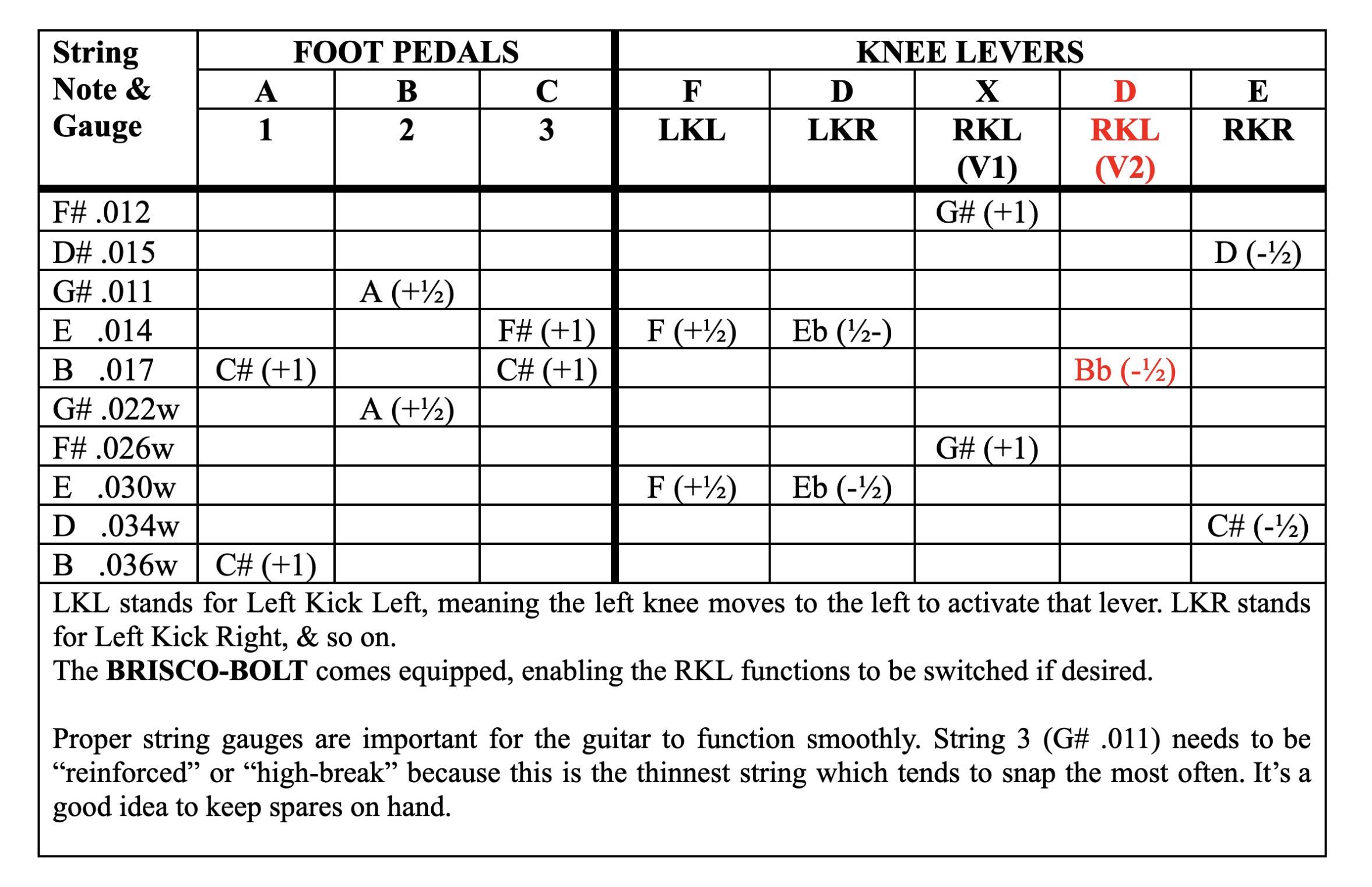
The Brisco Bolt is set up with the string gauges listed in the Tuning Chart. When replacing strings, BE SURE to use strings whose gauges & type match the list below. A deviation from these may require a slight adjustment of the nylon tuning nuts; or it might require relocation of a pull bar in the 5-hole pull finger to properly tune the different strings. Be sure to use WOUND strings where indicated below (by a “W”).
Adjustments
Pedal Height: Adjusting the pedal height can be easily done by loosening the lock nut on the pedal rod at the ball joint connector. The ball joint can be loosened or tightened to change the height. Once the desired height is achieved, tighten the lock nut.
Knee Lever adjustments: Making sure the knee levers are set up correctly is very important. Before making any adjustment make sure your open strings are tuned to pitch. Next, tune the nylon tuners to where they touch the changer and the knee lever is straight up at a 90% angle. Loosen the knee lever stops. Engage the knee lever to the desired pitch and tighten the knee lever stop. Now your knee lever is at the optimal amount of travel. At this point your nylon hex tuners can be used for fine tuning adjustments. You can also adjust the “tilt” of the knee lever with the set screw on the inside of the knee lever slot.
Leveling the guitar: The rear legs have a Height Adjustment screw with a locking nylon nut at the bottom, above the rubber tip. Use this leveling adjustment to steady your Brisco Bolt on any uneven flooring.
General Care and Lubrication
WARNING: DO NOT use WD-40 (or the equivalent) on the rollers or any part of the guitar because this evaporates and leaves a gummy residue, which eventually causes the moving parts to stop moving freely.
You should think of any pedal steel as a machine as much as a musical instrument. As such, it does need to be properly maintained and lubricated to make sure it is performing at its optimal. The guitar is finished with a 3M vinyl wrap and can be cleaned with a dry microfiber cloth or with a non-abrasive cleaner such as Windex. When using SPRAY-type polishes or cleaners, NEVER spray them directly at or onto any part of the guitar. Instead, spray the product onto a soft cloth and apply to the appropriate part of the guitar with the cloth.
Make sure all parts in the under-carriage have a little wiggle room. Parts that become too tight or jammed will lead to issues. Cross-shafts use nylon bushings and do not need lubrication. Lubrication should be done on all pivot and metal-to-metal contact points under the guitar, about 2 or 3 times per year. A light, high-grade 3-1 machine oil is recommended. Transmission fluid works well to clean and lubricate the changer. The roller nut requires occasional lubrication for smooth string return.
The pedals are mounted on a steel shaft.To keep the pedals working freely, use a small drop of light oil on the shaft where the pedal is attached 2 times per year. Please Note: The ball joint connection at the pedal rod-end is not lubricated. If a slight squeak should occur in 1 of these, use a small drop of light oil. Adjusting the Changer Return Springs NOTE: Do NOT attempt this until you have exhausted all other possible remedies to this problem (such as lubrication, string ball ends stuck in mechanism, etc.)